What is deep work?
Cal Newport, a computer science professor at Georgetown University, defines deep work as focused work without distraction that pushes your abilities to their limit. Writing, studying, coding and designing all benefit from it. The opposite is shallow work: email, chat and admin.
What are the 4 rules of deep work?
1. Work deeply. Do not wait for motivation. Plan when, where and how long you will focus, and make it a ritual.
2. Embrace boredom. If you grab your phone at every idle moment, your mind loses the ability to stay with one thing. Practice waiting without a screen.
3. Quit social media. Newport's point is to use tools on purpose. Keep the ones that clearly serve your goals and drop the rest.
4. Drain the shallows. Batch email and admin into set windows so your best hours go to your most important work.
How many hours of deep work can you do a day?
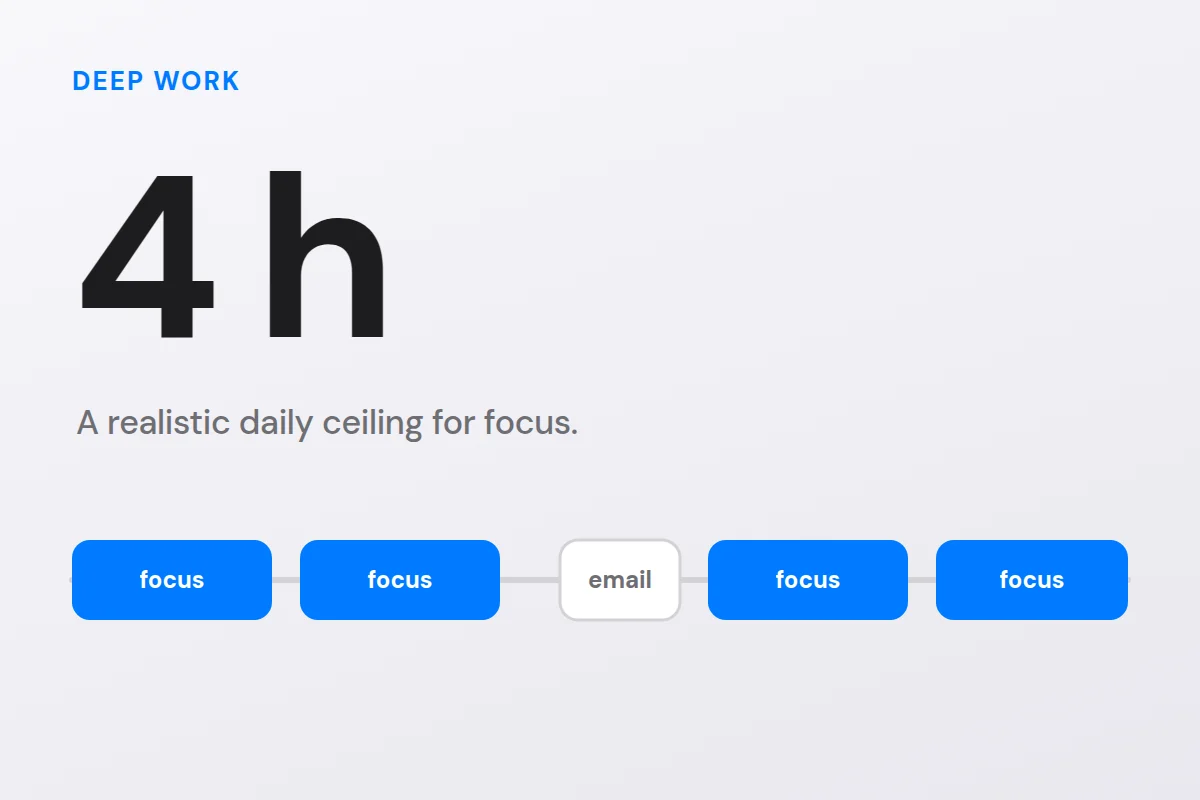
About four hours is a practical ceiling for most people. Newport points to research on expert performers, such as elite violinists, who rarely did more than about four hours of focused practice a day (Ericsson and colleagues, 1993). If you are starting out, one solid hour a day is a strong goal.
A simple daily deep work routine
1. Same time, same place. Mornings work well for many people.
2. Set a clear target. Write the one outcome for the session.
3. Use a timer. Start with 25 to 45 minutes and build up.
4. Protect the block. Phone away, notifications off, door closed if you can.
5. Shut down on purpose. End the day by noting where to pick up tomorrow.