What is the Stroop effect?
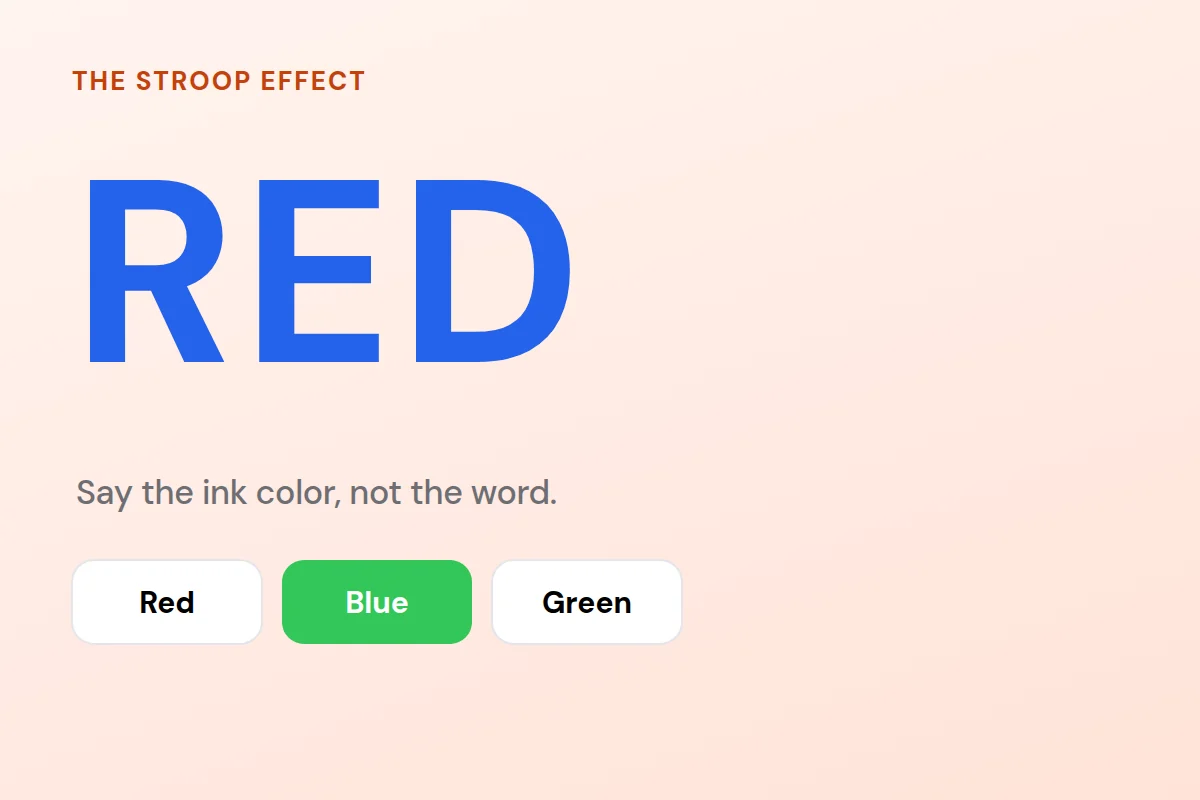
Look at the word RED printed in blue ink and say the ink color out loud. Most people slow down or even say "red" by mistake. That slowdown is the Stroop effect, first described by John Ridley Stroop in 1935.
Why does it happen?
For a fluent reader, reading happens automatically. You cannot see a familiar word without reading it. When the word and the ink disagree, two answers compete, and your brain has to hold back the automatic one. That takes a little extra time (MacLeod, 1991).
What does the Stroop test measure?
It measures attention control, sometimes called inhibition: choosing the right response while ignoring a strong but wrong one. Researchers have used it for decades in studies of attention, ageing and stress.
Can Stroop practice improve self-control?
Practice clearly makes you faster and more accurate at the task. Whether that carries over to everyday self-control, like resisting your phone, is less certain. The most useful way to think of it is as a short, demanding attention workout: it asks you to stay deliberate when your brain wants to rush.
How to practice the Stroop effect
1. Name the ink, not the word. Say it in your head or tap the matching button.
2. Go for accuracy first. Speed comes with practice.
3. Add colors as you improve. More options make the conflict harder.