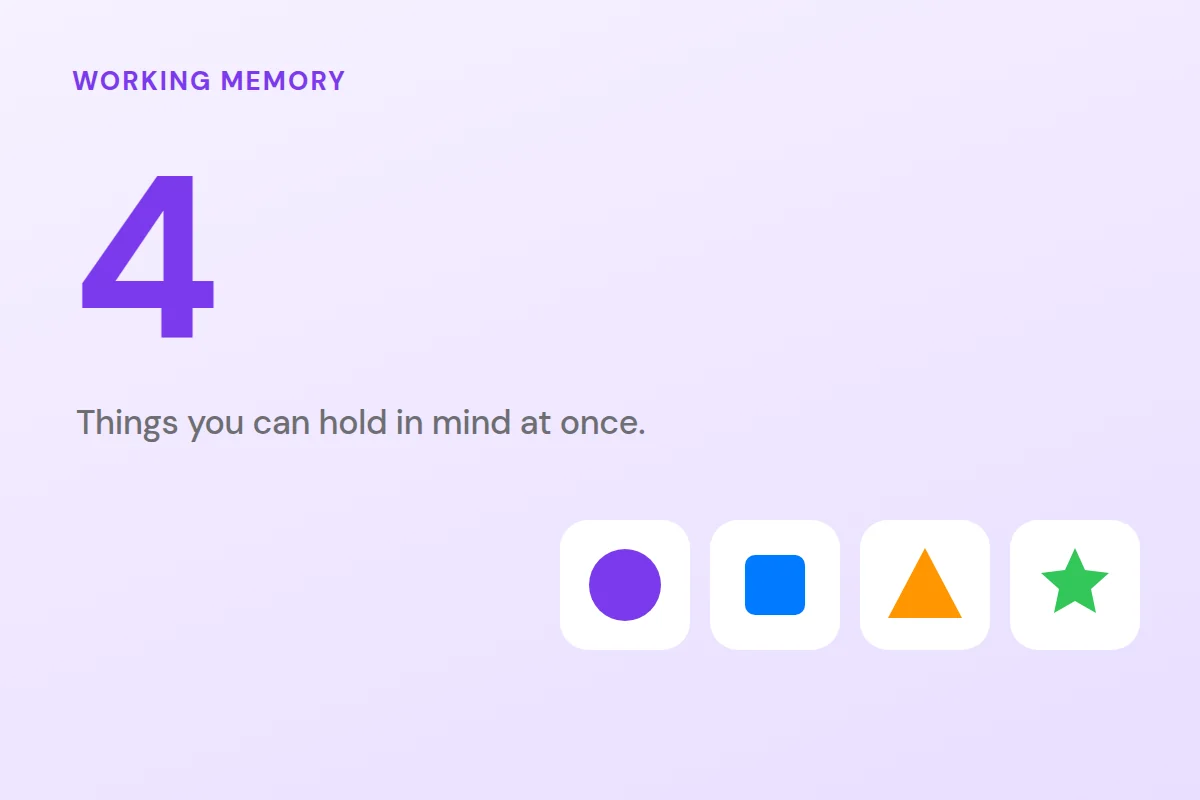
What is working memory?
Working memory is the mental workspace you use right now: keeping a phone number in mind, following a conversation, doing sums in your head. It is small. Most people can juggle about four chunks of information at once (Cowan, 2001).
What are the main types of memory?
- Sensory memory: a split-second trace of what you just saw or heard.
- Short-term memory: holding information for seconds without working on it.
- Working memory: holding and using information at the same time.
- Long-term memory: what you keep for days or years.
- Explicit memory: facts and events you can consciously recall.
- Implicit memory: skills and habits, like typing or riding a bike.
- Episodic memory: your personal experiences, tied to a time and place.
How can you improve working memory?
1. Chunk information. Group items into meaningful units, like reading a phone number in three parts.
2. Cut distractions. Every interruption uses up part of your limited workspace.
3. Write things down. Free your working memory for thinking instead of holding.
4. Sleep well. Tired brains hold less.
5. Practice at your edge. Memory games like Pattern Memory make you better at the task. Large reviews find limited transfer to other skills, so use them as focused practice, not a cure-all (Melby-Lervåg and Hulme, 2013).
What is spaced repetition?
In the 1880s, Hermann Ebbinghaus showed that we forget new information quickly, most of it within days, unless we review it. Reviewing at growing intervals slows that forgetting. Across hundreds of studies, spreading practice out beats cramming the same amount into one session (Cepeda and colleagues, 2006).
A simple schedule: review new material the next day, again after about a week, and again after a month. Many people call this the 2-7-30 rule, but the exact days matter less than spacing the reviews out.