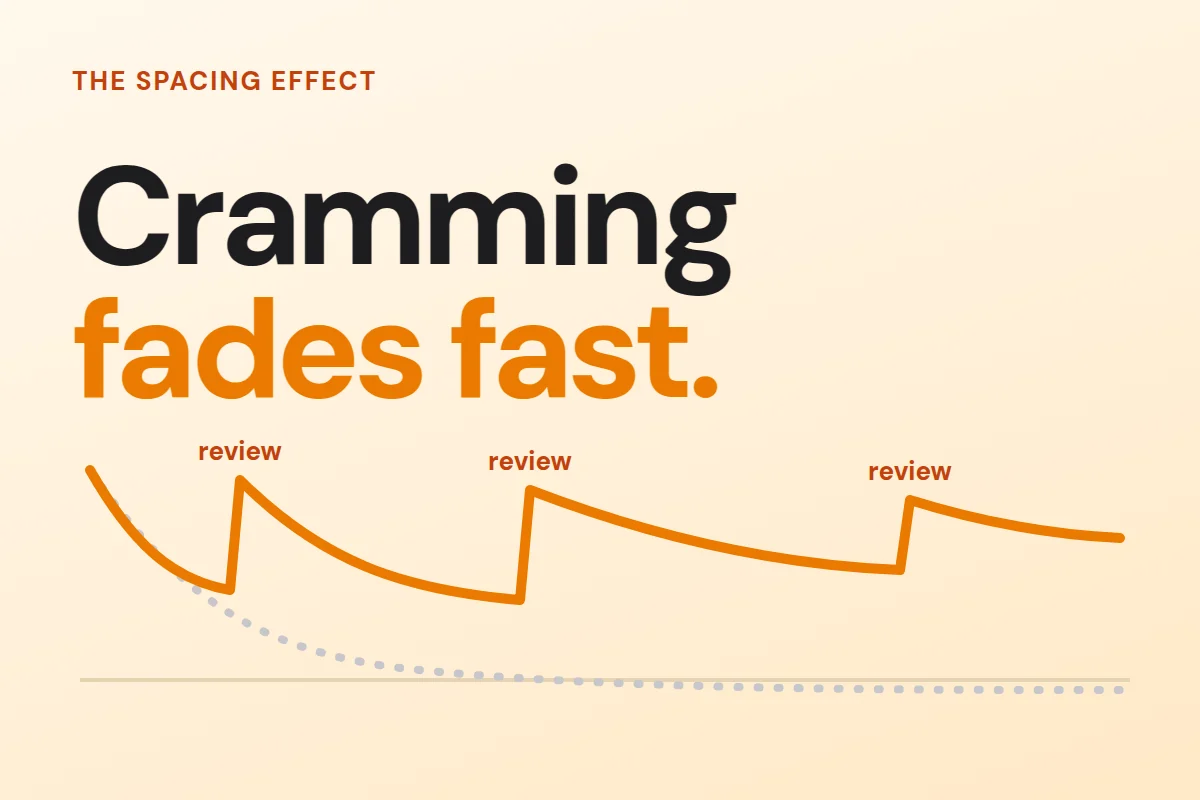
What is the spacing effect?
If you study something three times, you will remember it better when those sessions are spread across days than when they happen back to back. That is the spacing effect. Psychologist Hermann Ebbinghaus first described it in 1885, and a large review of hundreds of studies confirmed it (Cepeda and colleagues, 2006).
Why does cramming fail?
Cramming feels productive because the material is fresh and familiar. That familiarity fades fast. Ebbinghaus showed that much of what we learn is forgotten within days unless we review it. Cramming can get you through tomorrow's test, but most of it is gone a week later.
Why does spacing work?
When you return to something after a gap, you have to work a little to remember it. That effort strengthens the memory, and after each review the memory fades more slowly. A review of study techniques rated spaced practice and self-testing as the two most useful methods for students (Dunlosky and colleagues, 2013).
A simple spaced study schedule
1. Learn it today. Take notes and make a few questions.
2. Review tomorrow. Test yourself before you look at the notes.
3. Review after about a week.
4. Review after about a month.
Exam in two weeks? Squeeze the gaps: today, in two days, in a week, then the day before. The exact days matter less than spacing the reviews out.
Spacing works for skills too
The same idea applies to practice: a few minutes a day beats one long weekly session, whether it is music, a language or focus training.