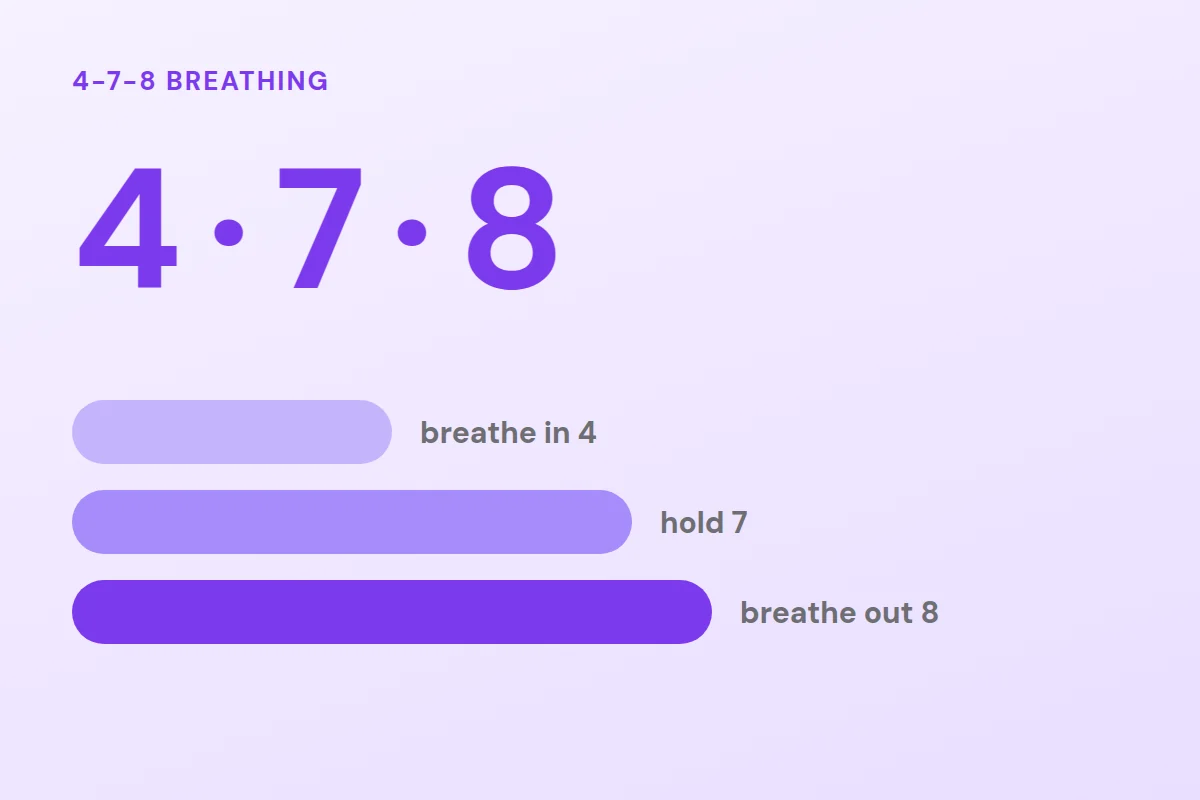
What is 4-7-8 breathing?
4-7-8 breathing is a slow breathing pattern with a long exhale. It was popularized by Dr. Andrew Weil and comes from yoga breathing practice. Each round takes 19 seconds, so your breathing slows to about 3 breaths a minute.
How do you do 4-7-8 breathing?
- Breathe out fully through your mouth to start.
- Breathe in quietly through your nose for 4 seconds.
- Hold your breath for 7 seconds.
- Breathe out through your mouth for 8 seconds, slowly and completely.
Do 4 rounds to start. If the hold feels too long, count faster. The ratio matters more than exact seconds.
Does 4-7-8 breathing help you sleep?
Slow breathing in general is linked to more relaxation and less anxiety (Zaccaro and colleagues, 2018), which can make it easier to fall asleep. Research on the 4-7-8 pattern itself is still small. One study in sleep-deprived young adults found it improved measures of heart rate variability, a sign of a calmer nervous system (Vierra and colleagues, 2022). It is a reasonable, free part of a bedtime routine, not a cure for insomnia.
4-7-8 or box breathing?
Box breathing (4-4-4-4) keeps every step equal and suits moments when you want to feel calm but alert. 4-7-8 has a longer hold and exhale and is often used to wind down. Try both and keep the one you will actually do.
Is it safe?
The breath hold can make some people lightheaded. Start with fewer rounds, sit or lie down, and stop if you feel dizzy. If you have a heart or lung condition, or are pregnant, ask your doctor before breath holds.