What is coherent breathing?
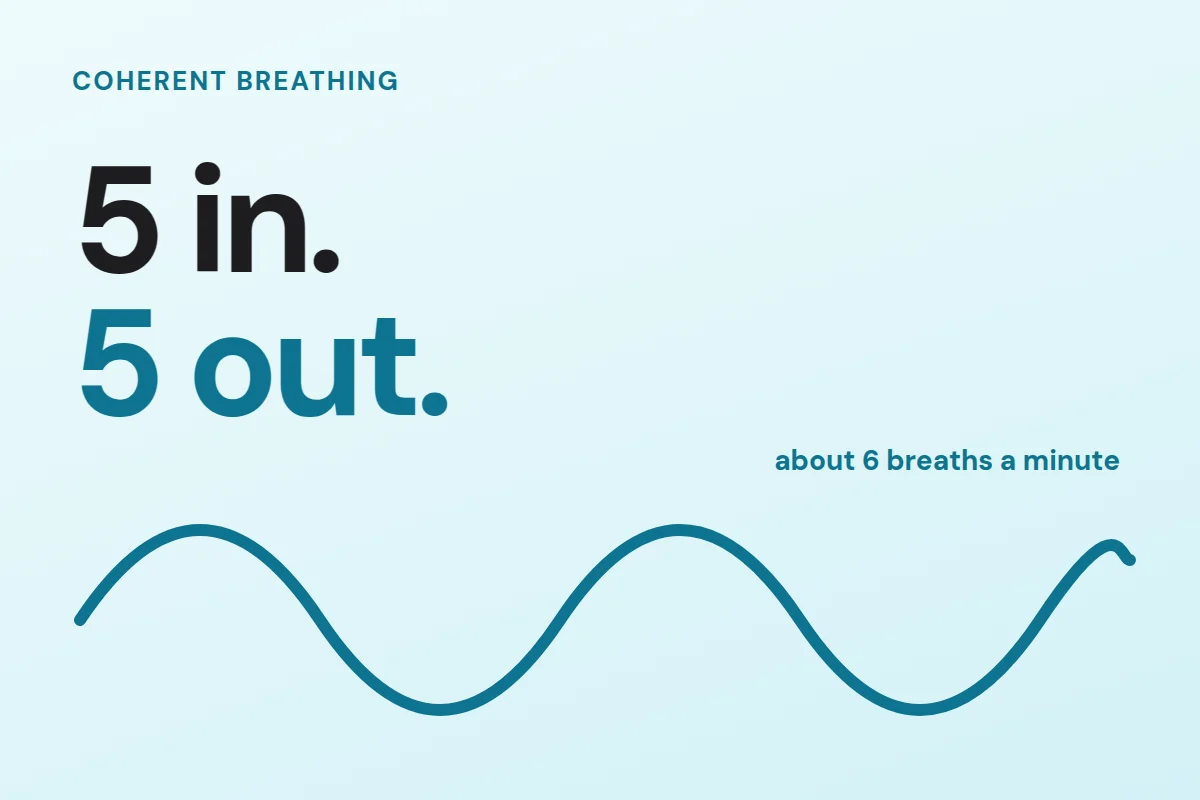
Coherent breathing is slow, even breathing at about 5 to 6 breaths a minute, with no breath holds. A simple version: breathe in for 5 seconds, breathe out for 5 seconds. It is also called resonance breathing.
How do you do coherent breathing?
- Sit comfortably and relax your shoulders.
- Breathe in gently through your nose for about 5 seconds.
- Breathe out slowly for about 5 seconds, without pausing at the top or bottom.
- Continue for 5 minutes, keeping each breath soft rather than deep and forced.
Why 5 to 6 breaths a minute?
Your heart rate naturally rises a little when you breathe in and falls when you breathe out. At around 6 breaths a minute, for most adults, this rhythm lines up with other natural rhythms in the body and the swings get bigger. That shows up as higher heart rate variability, a sign of a flexible, calm nervous system. This is the basis of heart rate variability biofeedback (Lehrer and Gevirtz, 2014).
Does it help?
A review of slow breathing studies found that breathing below about 10 breaths a minute is linked to more relaxation and less anxiety (Zaccaro and colleagues, 2018). Coherent breathing is an easy way to get there, because there are no holds to manage.
Coherent breathing or box breathing?
Both are slow. Box breathing adds holds, which some people find focusing and others find uncomfortable. Coherent breathing has none, so it is a gentle place to start.