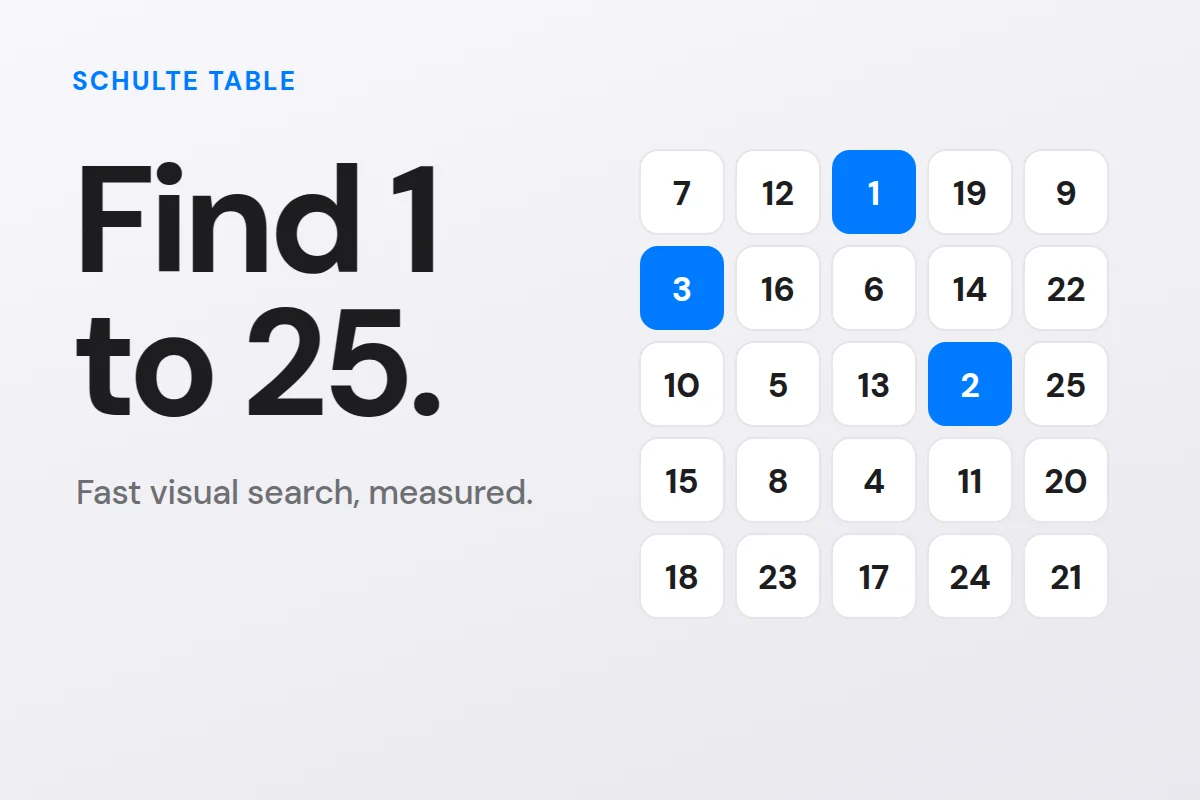
Does the Schulte table really work?
It depends on what you expect. Practice reliably makes you faster at the table itself, because you get better at visual search and at holding focus while the clock runs. That makes it a good short attention exercise with a clear score.
Bigger claims are a different story. Training studies in general find that gains carry over mostly to similar tasks, not to broad abilities (Melby-Lervåg and Hulme, 2013).
Does the Schulte table improve reading speed?
There is little good evidence for it. Reading speed is mostly limited by how fast you understand language, not by how much your eyes can see at once. A major review found that speed reading techniques that push you to read much faster usually reduce understanding (Rayner and colleagues, 2016).
What is a good Schulte table time?
Times vary a lot between people, so use these as rough guides and focus on beating your own best:
- 4×4 grid (1 to 16): about 15 to 25 seconds when you start, under 12 seconds with practice.
- 5×5 grid (1 to 25): about 30 to 45 seconds when you start, under 20 seconds with practice.
How to get the most from it
Do a few rounds as a warm-up before study or work, shuffle the grid every time, and track your best time over weeks. Measure your own speed with our free 4×4 Schulte table.